How to implement a local and global content strategy
blogDetail.updated April 2, 2026


blogDetail.subscribeCard.title
blogDetail.subscribeCard.description
Almost every major brand has a global digital presence, but when they scale their content to match that reach, engagement doesn’t always follow.
From language and cultural differences to customer behavior and local regulations, many barriers stand in the way of brands adjusting their content strategies to match global business ambitions. When that challenge emerges, they have a decision to make: Standardize their content for its global audience, or adapt it for regional audiences?
This is where the balance between local and global content strategies is critical. To navigate cross-border content operations successfully, brands need to find a way to protect their global identities while ensuring regional teams can appeal to their local audiences.
In this post, we’ll explore what that global-local content strategy balance looks like, and how the right content platform architecture makes it achievable.
Local and global content strategy defined
A global content strategy refers to the approach a brand takes to the creation, distribution, review, and governance of content across a global ecosystem. It should communicate the brand’s core identity and message to its global target audiences, essentially exporting its appeal and its distinctiveness to overseas markets.
The problem is, global content ecosystems are vast and diverse, and necessarily span multiple regional ecosystems. Brands can’t talk to their customers in these regions in exactly the same way because a variety of cultural and market factors complicate engagement.
To deal with that variety, brands need a way to localize content and content experiences in order to maximize engagement.
With that in mind, local content strategy refers to the same kind of creation, distribution, review, and governance processes, but focused on serving their regional target audiences. Local content strategy typically involves content teams dedicated to specific regions, who are responsible for creating content and executing localized content workflows.
Empowering regional teams
These regional teams are often the true experts in their markets. They understand the language, cultural nuance, customer expectations, and regulatory pressures that influence how content is received.
In many organizations, these teams act as centers of excellence for their markets, interpreting the global brand and global content strategy in ways that resonate with local audiences, and course-correcting when challenges emerge. That work might include launching unique campaigns, websites, and landing pages, maintaining different social media channels, and observing local regulations.
That means local teams need to be able to not only ideate and create content, but have some control over how, where, and when it gets published — and, when necessary, retired. They also need to be able to test and experiment on their content to optimize it for local tastes.
Finding local and global balance
Empowering regional teams means ceding some central control of content — along with brand voice and messaging. Brands that don’t localize their content, however, and that choose instead to standardize across the globe, risk undermining engagement by not accounting for regional cultural differences and nuances.
That probably won't come as a surprise. Successful global brands have long understood that multilingual content experiences influence whether customers buy at all. CSA Research found that 76% of online shoppers prefer to buy when product information is available in their own language, and 40% will not buy from websites in other languages.
For content marketers, the implication is clear: Language accessibility is not just a usability detail. It can directly shape conversion.
And yet, brands cannot give local content teams carte blanche to do whatever they want with content because, as mentioned, they risk fragmenting their unique identity and voice, introducing inaccuracies into content, diluting global brand guidelines, increasing duplication, and ultimately confusing audiences.
Without those shared standards, the brand experience quickly becomes inconsistent for various international audiences and fractured across different markets.
Another problem with local autonomy is the sheer volume of content created, with multiple teams each working to fulfill their own objectives and campaigns. The more content within a brand’s global marketing ecosystem, the harder it is to manage and govern — and the higher the likelihood of content chaos.
Why translation isn’t enough
It’s important to note that local and global content marketing strategy isn’t just a question of translating content into different languages, or adjusting currency and units of measurement.
As we mentioned, local content strategy must account for myriad cultural, geographic, economic, societal, and even seasonal differences in order to capture audience attention, build trust, and strengthen relationships.
In other words, content teams aren’t just seeking to translate textual content; they’re seeking to translate the brand itself at the same time. And that job becomes harder at scale, especially for organizations that maintain multiple websites or that own multiple brands.
The good news is, there’s a way to achieve that. The key to finding a balance between local and global content strategy is the software architecture on which brands build their content experiences.
Ideally, that architecture offers standardized protection for core brand identity and messaging, along with flexibility to customize and tailor content for regional optimization.
But how does architecture actually enable content strategy at global scale? How can brands model content to fit a global infrastructure — and get that job done without creating cross-border headaches?
Let’s use the Contentful digital experience platform (DXP) as an example.
Local-global strategy in Contentful
Modern content platforms, like Contentful, make it possible to design content ecosystems that support both global governance and local autonomy.
The cornerstone of local-global content strategy in Contentful is a centralized, global space that contains core brand content assets for all regions. While these assets are managed centrally, they can be shared and distributed wherever they’re needed — to content teams working in local spaces (locales), with their own front ends, channels, and websites.
For example, if a clothing brand wanted its regional content team in Australia to create and run a “Summer Celebration” campaign, and its team in Norway to run a “Winter Warmers” campaign, at the same time, the global space makes that easy.
Thanks to the global space, core content assets relating to brand identity and voice would be consistent across both teams. Working in their locale, the Australians would get to put out posts about “beachwear and hot weather style tips”, while the Norway team could focus on “cozy, cold-weather essentials”. That flexibility extends to metadata: the local teams could apply their own keywords and search engine optimization (SEO) strategies to capture local target audience interest and intent.
Long story short, each team has space to adapt to their local seasonal, cultural, and geographic variables while carrying the brand’s critical DNA through to audiences.
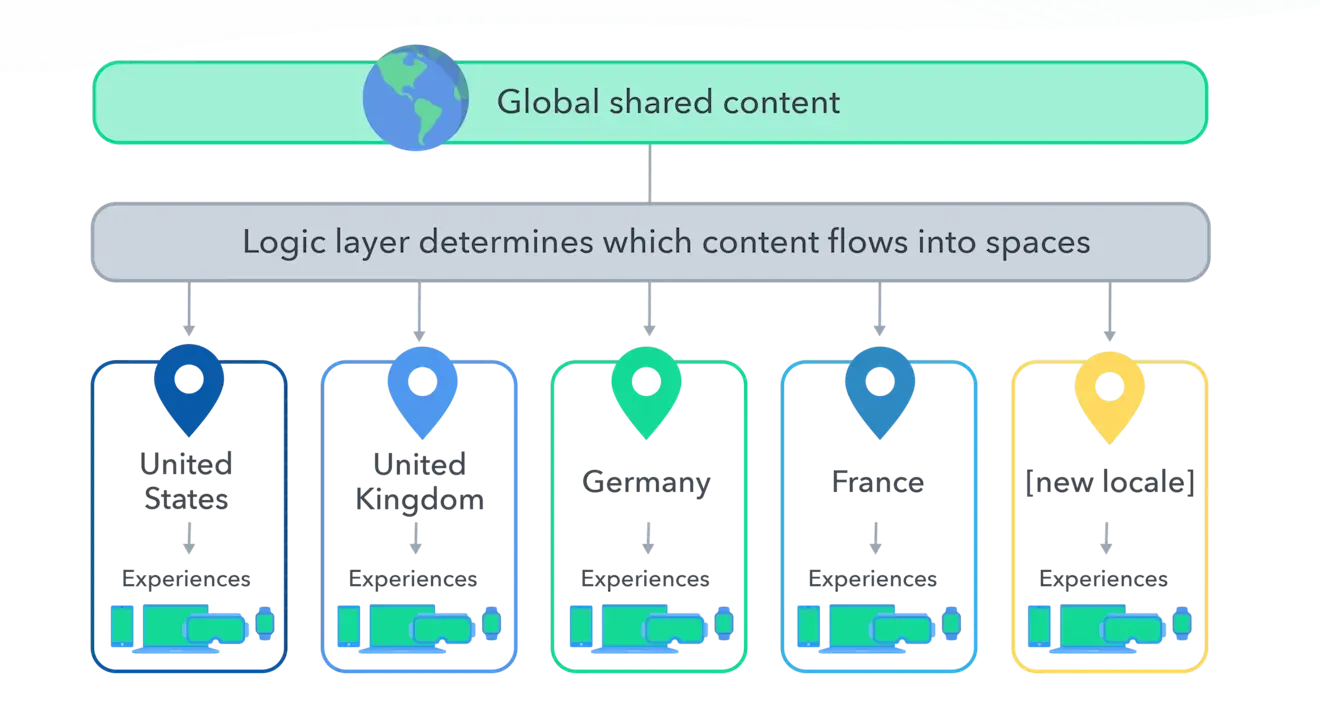
With the centralized, global space controlled exclusively by head office, the HQ content team can apply restrictions and role-based permissions to core content, locking down assets critical to the brand’s identity and messaging.
At the same time, local content teams have scope to create and manage their own assets, within their local spaces, and use them to build experiences that resonate with regional audiences. Since they don’t have the same access to the global content space, they don’t need to worry about undermining the core message that shapes the brand’s global identity.
This kind of local-global strategy is possible thanks to Contentful’s application programming interface-first (API-first) design philosophy. API-first means that the entire digital ecosystem is code-agnostic: Assets can be used in any context, on any platform or channel and by any local team, without any risk of formatting or compatibility issues.
Contentful in action: A hybrid global content strategy
Here’s an example of a local and global content strategy powered by Contentful.
A global furniture retailer needed to hybridize its content strategy to balance the requirements of local content teams catering to audiences in dozens of markets, with a central need for brand consistency.
Working in Contentful, the company developed a full-page app to manage the synchronization of content across multiple spaces. The app allowed head office content team members to select content by type and then have that content automatically synchronize to specific regional markets whenever it was published, unpublished, or archived.
The synchronization occurred via webhooks, triggered by a cloud function. The cloud function also performed other critical global-local synchronization processes, which verified:
If the content type existed in the local space — if it didn't, it created it.
If the content type was up to date with the global source space — if not, it updated it.
If the local market space already had the content localized — if so, it didn’t overwrite it.
If any necessary migration step needed to be performed — if not, it automatically performed those steps before applying any content changes.
The cloud function ensured the consistency of the organization’s global content marketing strategy across its ecosystem. That operational foundation not only sped up the content creation process but reduced the potential for human error amongst local content teams replicating content in their own spaces.
Evolving your local and global content strategy
Global markets evolve, and so should your content strategy. You’ll need to adapt to new challenges and emerging trends, integrate new technologies, and scale to meet growth goals.
The Contentful digital experience platform (DXP) is built to power that evolution. Here’s what that makes possible:
Modular content
Content in Contentful is completely modular: You can design content experiences at a component-level, and then swap or reuse those components to spin up new experiences quickly. This structured approach is ideal for localization because content doesn’t need to be recreated from scratch: Regional teams can simply nudge existing pages, updating headers, images, or body text to align with their audience expectations.
Global omnichannel freedom
Leveraging an API-first design philosophy, Contentful supports omnichannel marketing strategies with truly global scope. All content within the Contentful ecosystem can be published on any channel or touchpoint, without any risk of formatting errors or fragmentation.
Locale-centric workflows
Contentful spaces support locales, which can be localized to display regionalized versions of content, including translated text, adjusted cultural references, and scheduled publishing times. This locale-based publishing capability helps brands retain the structure and messaging of their core content, update that content quickly when needs change, and scale seamlessly as they reach out across new markets.
Global content automation
Contentful’s AI Actions include translation and localization features that can be tailored to specific regions and languages with the click of a button. Brands can use AI Actions to automatically translate text and SEO metadata into different languages in seconds, adjust digital assets to align with cultural nuances, and even suggest localized content to enhance experiences.
Testing and personalization
Contentful supports native testing and experimentation, including A/B testing, in order to enable regional teams to optimize their content experiences for audiences without any need for developer intervention. Built-in testing and experimentation not only enables personalization at a regional level but also ensures that these regional, personalized experiences are based on hard data rather than standardized global assumptions.
Wrapping up
In global and local content strategy, flexibility is as important as consistency. Contentful provides both, and serves as a foundation on which to adapt and evolve that strategy over time.
That foundation is critical to scaling. In order to power international growth, brands need to be confident that their content strategy will deliver on their global business objectives and deepen engagement with their new, local audiences.
Contentful makes that possible by building speed, simplicity, and efficiency into content workflows from the ground up, supercharging production with AI automation, and making it easier than ever to find and optimize the balance between global standardization and regional expression.
If you’re ready to transform your local and global content strategy, we’re ready to guide you: Learn more about our AI-powered translation capabilities, and our full range of AI Actions, or get in touch with our sales team to arrange a platform demo.

blogDetail.subscribeCard.title
blogDetail.subscribeCard.description
blogDetail.authors

As Senior Manager of Professional Services, Georgina leads a highly skilled technical team in post-sales consulting. Her journey with Contentful began as a Solutions Architect, where she honed her ability to translate complex technical scenarios into actionable insights.
blogDetail.relatedArticles

Making the case for composability during the Great Content Collapse
March 17, 2026

Content collaboration and deployment simplified for global teams
June 10, 2025

Simplify brand activation campaigns for global consistency
June 9, 2025