Agentic AI vs generative AI: When you need AI to act, not just create
Published on August 24, 2026


Inspiration for your inbox
Subscribe and stay up-to-date on best practices for delivering modern digital experiences.
Businesses are increasingly reliant on AI to maintain a competitive edge. AI tools are competing on a number of features, from the quality of their output to their ability to generate different kinds of content — and increasingly, their autonomous capabilities.
Agentic AI and generative AI are two categories of AI that you'll commonly encounter when researching and choosing AI tools to help your business become more productive and efficient, and knowing the difference (and where they overlap) will help you make the right investments.
This guide explains the difference between agentic AI and generative AI and how AI can address different parts of your content creation and publishing workflows.
What is generative AI?
Generative AI is familiar to most by now: You ask it to write text or create an image, and a short time later, the result of your prompt is returned. This started as simple chat interfaces and now also allows you to provide your own reference materials or links. Some generative AI can also search the web for additional information to include in responses.
Generative AI works as follows: You provide a prompt — instructions to the AI — that is then passed to the AI model, an algorithm trained on huge datasets. A response is then generated based on that prompt. You can build context through your ongoing chat, with the full conversation being passed back to the model so that the next reply can be based on it.
There are general-use models and models trained for specific tasks. Text is usually generated by large language models (LLMs), and there are also models for video (vision-language models, or VLM) and audio. AI tools may also incorporate other traditional models for tasks like statistical analysis.
The most well-known example of generative AI is ChatGPT, the tool that popularized AI backed by LLMs that you interact with through a chat interface. Other popular generative AI tools are Google Gemini's image generator (interestingly named Nano Banana) and AI-powered content translation tools.
What is agentic AI?
Agentic AI can refer to two concepts: AI agents that can act autonomously (i.e., with agency) or the application and orchestration of AI agents to solve a problem. While this may seem confusing, the terms are often used interchangeably: In each case, you're asking AI agents to do something on your behalf, either directly or through an orchestration tool.
Agentic AI doesn't need to be prompted to perform each action. It is given a goal, access to tools, and memory to track its progress, and can then operate on its own. It can take over a full workflow or perform specific tasks and then defer to human operators for final decisions or approval.
Agentic AI is rapidly becoming key to efficient workflows in many enterprises, from tools like Claude Code and teams of agents that can work with software developers to develop apps faster (writing code, creating files, and running tests) to AI customer support agents that go beyond helpful chatbots to complete specific tasks like bookings, billing records, and solving other customer problems. New capabilities have also made agentic AI suitable for managing entire creative, marketing, and publishing workflows.
Generative AI vs agentic AI: Summary comparison table
Generative AI has been quickly adopted by individuals and businesses for tasks like writing emails and providing answers based on given datasets, to generating creative output like images and videos. This still requires manual intervention — each output needs a specific user-initiated input. Agentic AI builds on these tools by using AI agents that can work autonomously based on a list of things to do (e.g., a multi-step workflow) or a broader goal.
Although closely linked technologically, agentic AI and generative AI work differently and serve different purposes. This means it's not always a matter of "one or the other"; you'll use both for different things or in different ways.
Generative AI | Agentic AI | |
|---|---|---|
Summary purpose | Generates content (text, images, audio, video) | Takes actions based on goals and the tools it has access to |
Interaction model | Output based on a specific prompt | Makes decisions based on a supplied goal |
Interface | Usually chat-like, with one discrete result per prompt | Takes instructions, then orchestrates how a solution will be reached using its available tools |
Autonomy | Reactive | Proactive; acts independently |
Memory | Stateless | Remembers steps in its workflow; works with intermediate results |
Tool use | May have built-in functionality for web search or calling other tools but not as part of a multi-step workflow | Can autonomously interact with other tools and AI using APIs, Model Context Protocol (MCP) |
Outputs/results | Returns content that can then be manually copied or saved for its intended use | Can return content or directly update database records, create blog posts, or handle any other action that can be performed programmatically |
Both generative and agentic AI can be run locally (if you have the hardware), but are usually provided by AI platforms that run in the cloud or are integrated into other platforms to perform tasks automatically or autonomously. For example, GitHub's Copilot offers agentic programming assistance, and AI Actions in Contentful streamline creative and content management workflows.
How generative and agentic AI work together
The AI agents used by agentic AI rely on generative AI (LLMs) to understand users and generate the instructions and content that they will pass on to other tools or return as output.
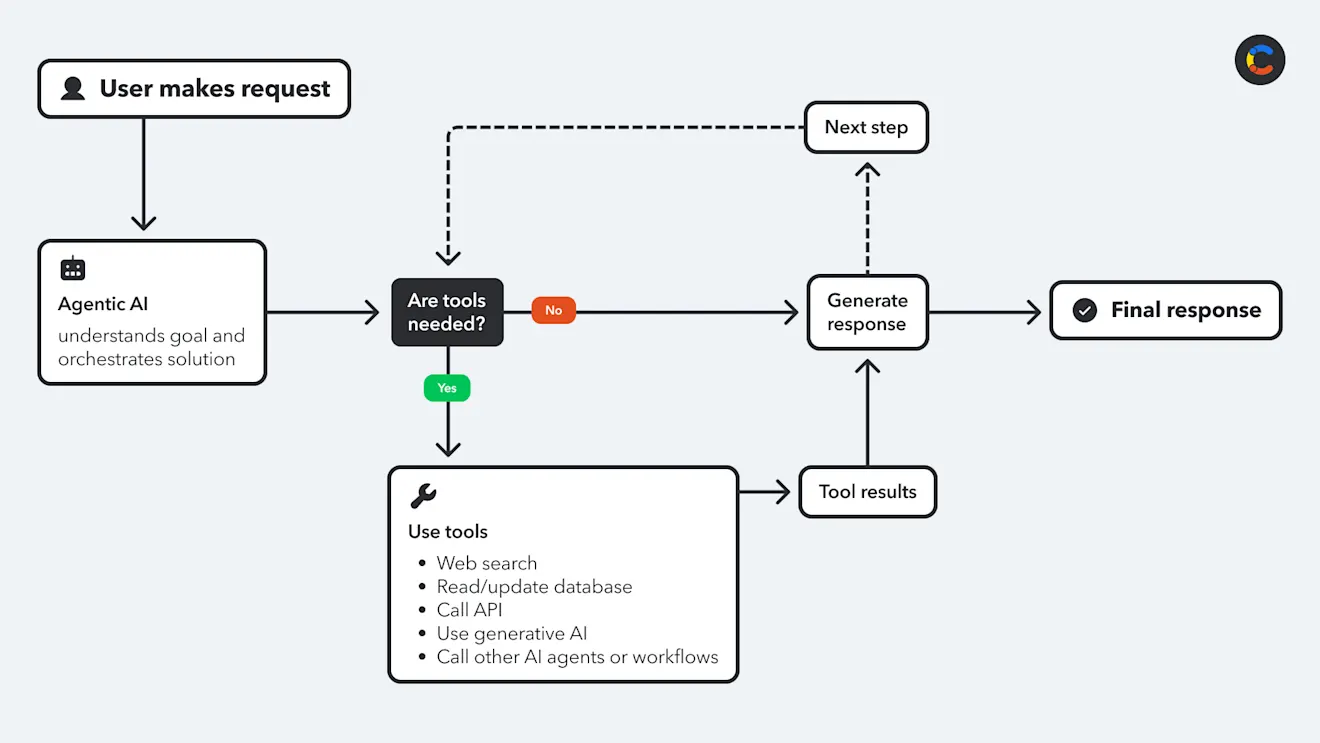
Agentic AI can then use different agentic AI tools built for different tasks. For example, an agentic workflow that creates blog posts can call on a generative LLM to write text and a VLM to draw the header image, then pass it on to another AI agent that handles the publishing workflow. AI assistants with a local presence on your device can also take over, using your apps and modifying local data.
AI agents can read and write data and interact with other services using APIs, including third-party SaaS APIs that may return data from their own purpose-specific generative AI. MCP describes programmatic access to AI so that it can understand how the tools it has access to work. Using these technologies, an agentic AI workflow is able to do things like read customer details from your CRM, process payments using your online payment platform, and even make phone calls using communication APIs.
While generative AI and agentic AI work together, autonomy and tool use create governance differences between them.
As generative AI is user-driven, responsibility for its output is clear: The user asked for it and implicitly approved of the output before applying it for the given task (for example, copying the output from the generative AI interface into an email, saving the resulting image and publishing it, etc.).
Agentic AI makes things more difficult: If an AI agent makes a decision, responsibility still needs to be assigned to a stakeholder. Controls must be in place to ensure that decisions that affect things like compliance and business outcomes have ownership, with human-in-the-loop (HITL) workflows that pause their final action until signed off on by someone with context and understanding of what this action will do. If your agentic AI workflows can access external tools, these governance concerns are amplified.
Both generative AI and agentic AI governance benefit from audit logging. Businesses need to be able to see who asked AI to create content or perform specific actions, especially if sensitive data is being submitted to AI tools hosted outside your network.
How generative AI is used for content and marketing
Practically speaking, generative AI can be used to create any kind of digital content a human creative can.
For example, it can generate text summaries for product descriptions or news items, synthesize images and video for ads, and answer questions based on your data for customer support or internal research using retrieval-augmented generation (RAG).
Agentic AI use cases in content and marketing workflows
Agentic AI workflows do all of the above, but at scale because of their added autonomy. Rather than asking generative AI tools to take each individual step in a repeatable workflow (e.g., asking an LLM to write a blog post, asking an image generation tool to create the feature image, and then copy and pasting each into your CMS), agentic AI will call on its AI agents to take each step in turn and even work on steps in parallel. When given a broader goal, they can even figure out the steps on their own.
Creative teams can offload entire workflows to AI agents that will proactively work toward their set goals. For example, AI Actions in Contentful can take over a whole ecommerce content workflow: generating a product description, translating it into several languages, creating image variants, and finally alerting a human team member for final approval.
Why Contentful matters for generative AI
Structured, API-first content that is readily composable and reusable matters for AI. Not everyone has the resources to train their own generative AI models, and even if you do, timely, accurate responses rely on feeding up-to-date data to them.
Use cases including personalization, RAG, creating and remixing media, getting answers, and adapting content for different regions and channels all benefit from structured input. AI tools need to be able to access your data via APIs and understand its purpose and hierarchy through its metadata and structure.
Contentul provides this foundation: a content platform that lets you structure and describe your content the best way for your unique use case, with well-documented APIs for programmatic access, automation, and delivery. MCP support means that AI can connect and understand how to use your content.
Why Contentful matters for agentic AI
Generative AI and agentic AI need a platform for storage and collaboration with other agentic AI workflows, as well as with your creative teams. Features like versioning and audit logging are also important, adding guardrails.
When it comes time to publish, you also need distribution via global CDNs and APIs that make your content always available to apps, websites, billboards, and your users' own AI agents.
Contentful provides all of this in a unified digital experience platform with its own agentic AI content workflows that are flexible, efficient, and directly address governance concerns.
Contentful helps you leverage AI agents across your entire content and marketing workflows. For those who don't want or need to do it all themselves, the Contentful digital experience platform includes proven agentic AI workflows that take your ideas from draft to publishing in minutes, rather than days.
AI Actions can also be programmatically invoked by your own AI agents, giving them new abilities to integrate and streamline your content workflows and get the most long-term value out of your content investments.

Inspiration for your inbox
Subscribe and stay up-to-date on best practices for delivering modern digital experiences.
Meet the authors

Tobias Baganz is a Senior Solution Engineer at Contentful with more than 14 years of experience helping customers across Europe, the Middle East and Asia design solutions for complex business and digital experience challenges. With a background spanning customer success, marketing and solution consulting, Tobias is passionate about connecting technology to customer needs and helping teams maximise the value of their digital platforms.
Related articles
The power of personalization frameworks
April 14, 2026
How firmographic segmentation strategies target audiences more effectively
October 17, 2025

Headless, decoupled, and Contentful: A non-technical explanation for the confused
November 20, 2024